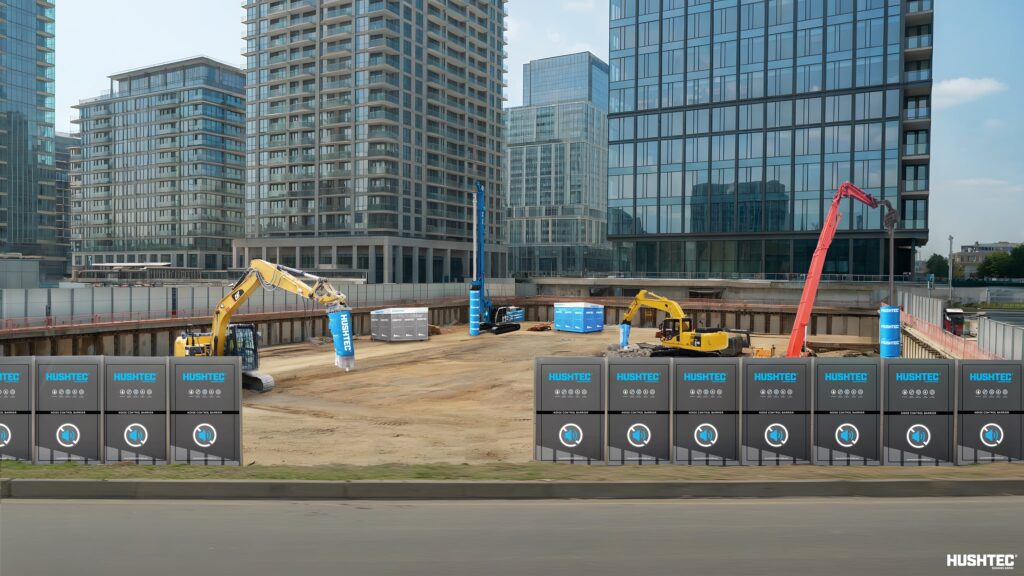



Quick answer: Use portable acoustic enclosures when noisy work moves around the site or lasts days to months. Use a permanent enclosure when a fixed plant will run in one place for years. Across EU member states, both help you meet the worker exposure limits in Directive 2003/10/EC and the local noise conditions attached to your permit.
A renovation in a historic city centre, a rail upgrade crossing three municipalities, a data centre fit-out next to a residential block: European projects put noisy work close to people, and the rules change from one city to the next. You need noise control that works under any permit and moves with the programme. This guide shows when a portable enclosure is enough and when you should build something permanent.
What is a portable acoustic enclosure?

A portable acoustic enclosure is a free-standing, sound-insulated structure that you can move, set up and pack down without foundations. It surrounds the noisy task and contains the sound at its source, before it reaches workers or residents.
The Hushtec Acoustic Tent range is one example. Each tent combines a galvanised scaffold frame on lockable castor wheels, Hushtec Premium acoustic panels, a transparent roof membrane and a PVC strip-curtain doorway. All three sizes arrive flat-packed, assemble in minutes without special tools, and pack down to a single pallet for transport between projects.
What is a permanent acoustic enclosure?

A permanent acoustic enclosure is a fixed structure built around a noise source that will stay in place for the long term. Typical examples include plant rooms, compressor and pump housings, generator compounds, and production machinery. Permanent systems sit on foundations, connect to building services, and carry ventilation, doors, and fire ratings designed for a single installation. Most need a building permit.
The European rules that shape your choice
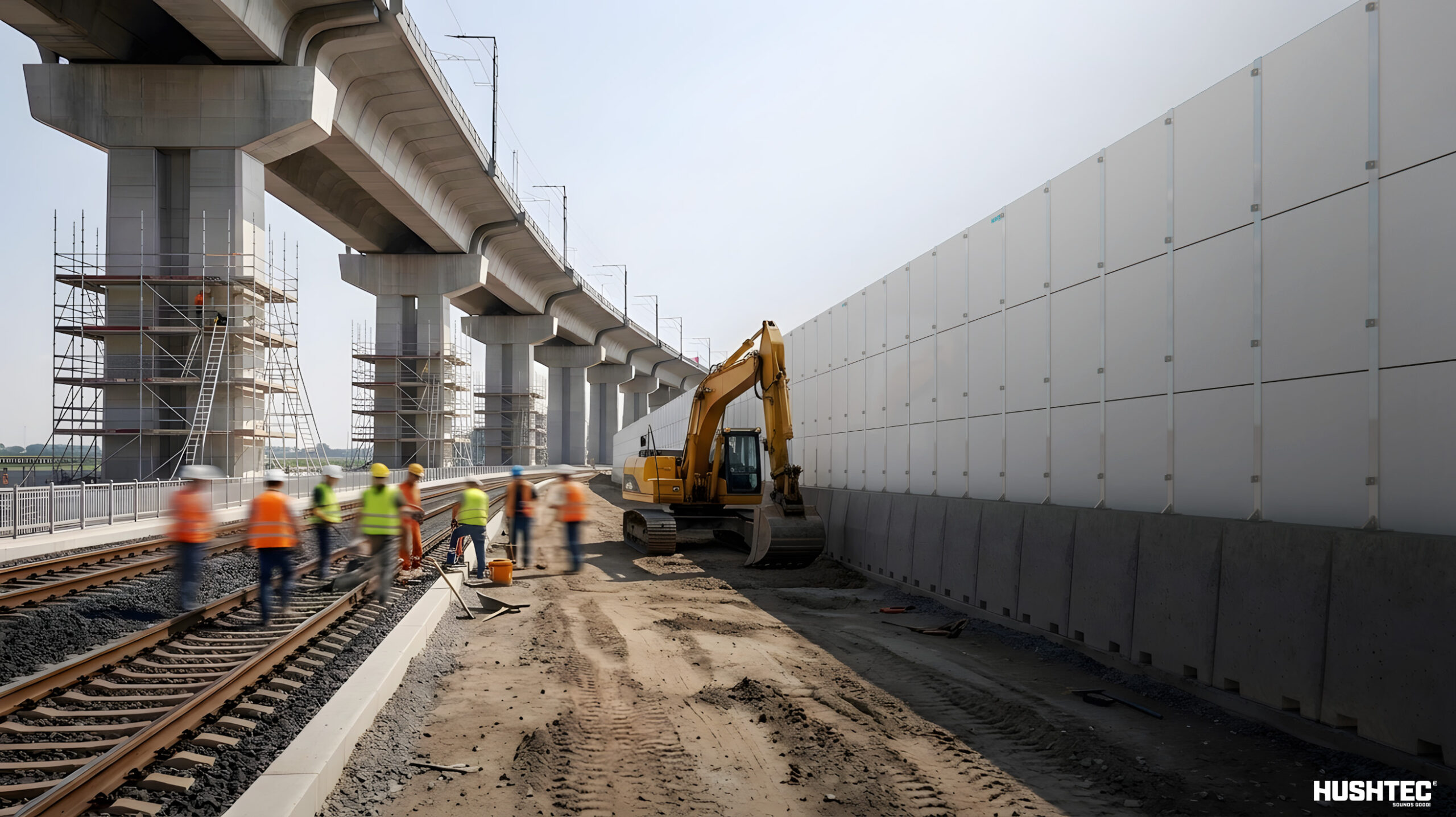
Worker exposure. Directive 2003/10/EC sets a lower exposure action value of 80 dB(A), an upper exposure action value of 85 dB(A) and an exposure limit of 87 dB(A). Employers must reduce noise at the source through technical and organisational measures before relying on hearing protection. Each member state transposes these values into national law.
Equipment noise. Directive 2000/14/EC requires outdoor equipment such as compressors, generators and saws to carry a guaranteed sound power level on its label. Delegated Regulation (EU) 2024/1208 replaced the directive’s measurement methods from 22 May 2025. Those labels give your acoustic consultant the starting figure for any noise prediction.
Neighbours. Member states, regions and municipalities set their own construction-noise limits and working hours. Germany’s AVV Baulärm is one example of a national framework; many cities add their own conditions on top. Your building or environmental permit decides the target at the nearest façade.
Because the neighbourhood rules change at every border, contractors working across several countries benefit from kit they can redeploy from one project to the next. Portable enclosures fit that model.
Portable vs. permanent at a glance
| Factor | Portable acoustic enclosure | Permanent acoustic enclosure |
| Typical use | Cutting, grinding, core drilling, fabrication | Plant rooms, compressor and pump housings, fixed generators |
| Duration | Days to months, or repeated short tasks | Years; treated as a fixed asset |
| Permits | No foundations for the tent; covered by the site noise plan | Often needs a building permit |
| Lead time | Standard sizes; assembles in minutes | Design, approval, fabrication and installation |
| Mobility | Rolls on casters; one pallet in transit | Fixed |
| Equipment access | Strip curtain and removable panels | Engineered doors and lift-out panels |
| Ventilation | Optional ventilation kit; suits hand tools | Designed airflow and heat rejection for running plant |
| Reuse | Moves between projects and countries | Tied to one asset |
| Cost profile | Lower upfront cost, reusable | Higher upfront cost spread over the asset’s life |
Five questions to settle first
- How long will the noise source stay put? Weeks or a few months point to a portable unit.
- Does the work travel? Rail lines, road corridors and floor-by-floor refurbishments suit an enclosure on wheels.
- Does the equipment burn fuel? Engines need engineered cooling, combustion air and exhaust routing. Keep generators and other combustion plant out of tents built for hand tools.
- What limit does your permit set, and where? Identify the façade or boundary point and ask your acoustic consultant to predict the level with the enclosure in place.
- How often do people, forklifts and long materials need access? Frequent traffic favours a larger tent with a wide strip curtain.
Expected performance

Lab ratings and site results differ. A panel’s rating describes how much sound it blocks under test conditions. On site, gaps at panel joints, an open doorway, the roof and sound travelling through the structure all reduce the result.
Hushtec rates its Acoustic Tent range at up to 66 dB, using ISO lab-tested Hushtec Premium panels rated STC 32 and NRC 0.9. European consultants usually work with the Rw rating from EN ISO 717-1, so ask Hushtec for the Rw value on the test report.
To get the most from the tent:
- Keep the strip curtain closed while cutting.
- Check panel joints after every move.
- Face the doorway away from residents.
- Use the ventilation kit instead of propping panels open.
- Set the tent on level ground so the base seals evenly.
Hushtec Acoustic Tents

| Model | Footprint | Height | Best for |
| Acoustic Tent 1.0 | 2.5 m × 2.5 m | 2.2 m | A single cutting or grinding station |
| Acoustic Tent 2.0 | 2.5 m × 3.9 m | 2.2 m | Longer materials, more tools |
| Acoustic Tent 3.0 | 2.5 m × 5.2 m | 2.2 m | Several workers, drilling, large-format fabrication |
Each tent resists water and UV, uses fire-retardant materials, contains no fibreglass, and comes with a 1-year warranty. Hushtec states that 90% of the panel materials are recyclable, and the frame and roof are reusable across deployments. That helps when your tender scores circular-economy or sustainability credentials. Optional add-ons include internal lighting, ventilation kits, anchor kits and custom branding.
Writing the enclosure into your noise management plan
Permit authorities respond to specific commitments. Record the enclosure model and panel rating, where it will sit in each phase, which activities happen only inside it, the operating rules for the curtain and joints, predicted façade levels with and without it, and your monitoring plan.
When a permanent system is the better buy
For a long-running plant, Hushtec’s AcoustiShield wall uses 70 mm fibre cement panels at 15 kg/m², delivers a field-tested 29 dB reduction and carries a 10-year structural and acoustic warranty. The Hushwall Permanent System and Custom Solutions cover larger engineered builds.
The Portable Hushwall gives 30 to 40 dB, depending on the panel, at heights of 2.4 m to 6.0 m without footings. It suits multi-year projects that will still move once or twice.
The hybrid approach
Many European sites combine both: a wall around the plant compound and an Acoustic Tent for the cutting that moves each week. Hushtec’s client list includes Vinci Construction and Freyssinet.
Frequently asked questions
What is the difference between a portable and a permanent acoustic enclosure?
A portable enclosure stands on its own frame, moves with the work and packs down after use. A permanent enclosure sits on foundations around a fixed noise source and stays for years.
What noise exposure limits apply to workers in the EU?
Directive 2003/10/EC sets action values of 80 dB(A) and 85 dB(A) and an exposure limit of 87 dB(A). Member states transpose these into national law.
Do construction noise limits differ between EU countries?
Yes. Each member state, and often each municipality, sets its own limits and hours. Check the conditions in your permit.
Is a portable acoustic enclosure a permanent structure under building rules?
In most jurisdictions, a wheeled tent with no foundations is temporary site equipment. Confirm with your local authority if it will stay in one place for a long period.
Can I move a Hushtec tent between projects in different countries?
Yes. Each tent packs down to a single pallet and reassembles in minutes.
Does Directive 2000/14/EC apply to acoustic enclosures?
The directive covers noise emitted by outdoor equipment such as generators and compressors, not the enclosure. Enclosures help you control that equipment’s noise on site.
Can I use an acoustic tent for a generator?
A standard acoustic tent is generally suited to temporary work such as cutting, grinding, drilling and fabrication. Generators need a purpose-designed enclosure that allows adequate cooling airflow and provides suitable exhaust silencing. Simply covering a generator can cause overheating and create safety risks.
What is the difference between STC and Rw?
STC is the sound transmission rating used mainly in the US, while Rw is the weighted sound reduction index used under international standards, including in the UK. Both describe how well a building element reduces airborne sound, but they use different rating methods, so the figures aren’t directly interchangeable.
Get a recommendation from Hushtec
Share your permit limits, receivers and programme with Hushtec, and we will recommend a setup. Book a free consultation, email hello@hushtecglobal.com or call +44 777 111 5472.