



An MRO hangar at a major European airport answers to three sets of noise rules at once. One protects ramp technicians. One maps the noise that reaches surrounding towns. One governs when authorities can restrict operations. Ground runs, APU tests, and ground power units touch all three.
This guide explains how each EU rulebook lands on maintenance operations, and how to plan noise control for aircraft maintenance facilities that satisfies all three without building a permanent test cell.
Rulebook 1: worker exposure under Directive 2003/10/EC
The Physical Agents (Noise) Directive sets the same thresholds in every member state, though each country writes them into its own law.
| Threshold | Daily exposure (LEX, 8 h) | Peak sound pressure |
| Lower exposure action value | 80 dB(A) | 112 Pa (135 dB(C)) |
| Upper exposure action value | 85 dB(A) | 140 Pa (137 dB(C)) |
| Exposure limit value | 87 dB(A) | 200 Pa (140 dB(C)) |
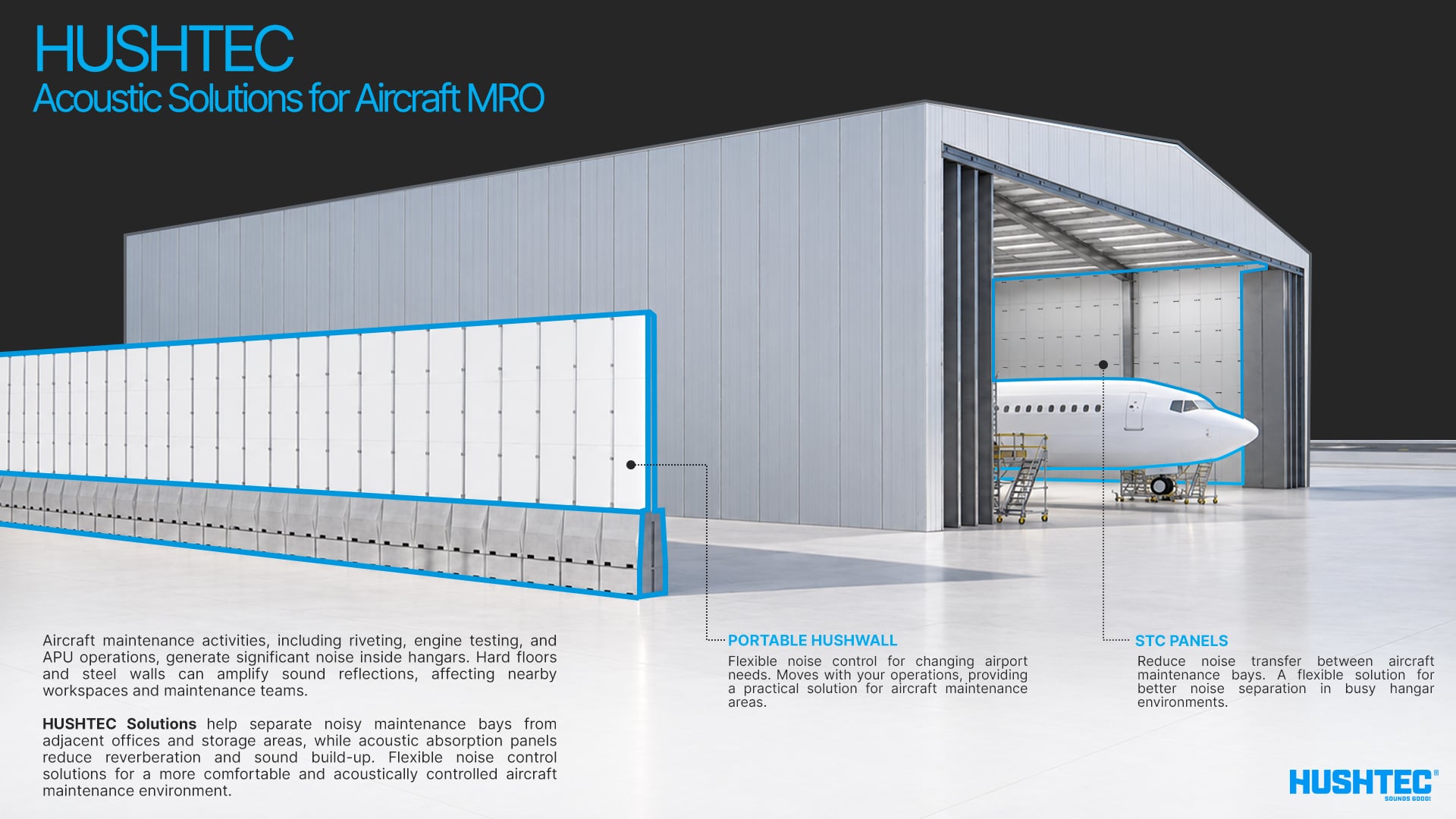
A full-power engine ground run produces roughly 130 to 140 dB at the operator position, and hangar work reaches 90 to 105 dB. Technicians pass the upper action value within minutes. The Directive requires you to reduce noise at the source and through technical measures first, with hearing protection as a backstop. Examples of these technical measures include aircraft acoustic barriers, equipment shrouds, and absorption panels.
Rulebook 2: The Environmental Noise Directive
Under Directive 2002/49/EC, EU countries must prepare strategic noise maps and action plans for major airports. These assess aircraft noise and the wider noise impact on surrounding communities. The plans can identify areas where noise needs to be reduced, although the measures chosen depend on the airport and national requirements.
Rulebook 3: The Balanced Approach Regulation
Regulation (EU) No 598/2014 applies when airports handling more than 50,000 civil aircraft movements a year are considering noise-related operating restrictions. Before introducing restrictions, authorities must assess measures such as quieter aircraft, land-use planning and changes to operating procedures, taking their likely effectiveness and cost into account.
The Regulation focuses on aircraft noise and airport operating restrictions, rather than noise from maintenance equipment. However, ground activities can also affect nearby communities. Acoustic barriers and equipment enclosures may help reduce noise from maintenance work, depending on the equipment, site layout and noise-control requirements.
Where ground noise comes from on an EU maintenance base
| Zone | Main sources | Typical operator-position level |
| Run-up areas | Full-power engine runs, intake and exhaust | ~130–140 dB |
| Taxiway and apron | Taxiing, ground power units, tugs | ~100–110 dB |
| Hangar interior | APU testing, riveting, reverberation | ~90–105 dB |
| Ground support equipment | GPUs, air conditioning carts, air start units | Varies; confirm on site |
Treat these as representative. Aircraft type, engine and ground conditions shift them, so measure your own site.
Matching aerospace acoustic noise control to each source
Effective aerospace ground operations noise control assigns one tool to each source.
- Run-up areas: the Hushtec Portable Hushwall, a modular wall you can redeploy when run-up positions move. An apron-rated version for jet blast, FOD safety and fuel exposure is in development.
- GPUs, air carts and air start units: a Hushtec Custom Shroud built around the unit.
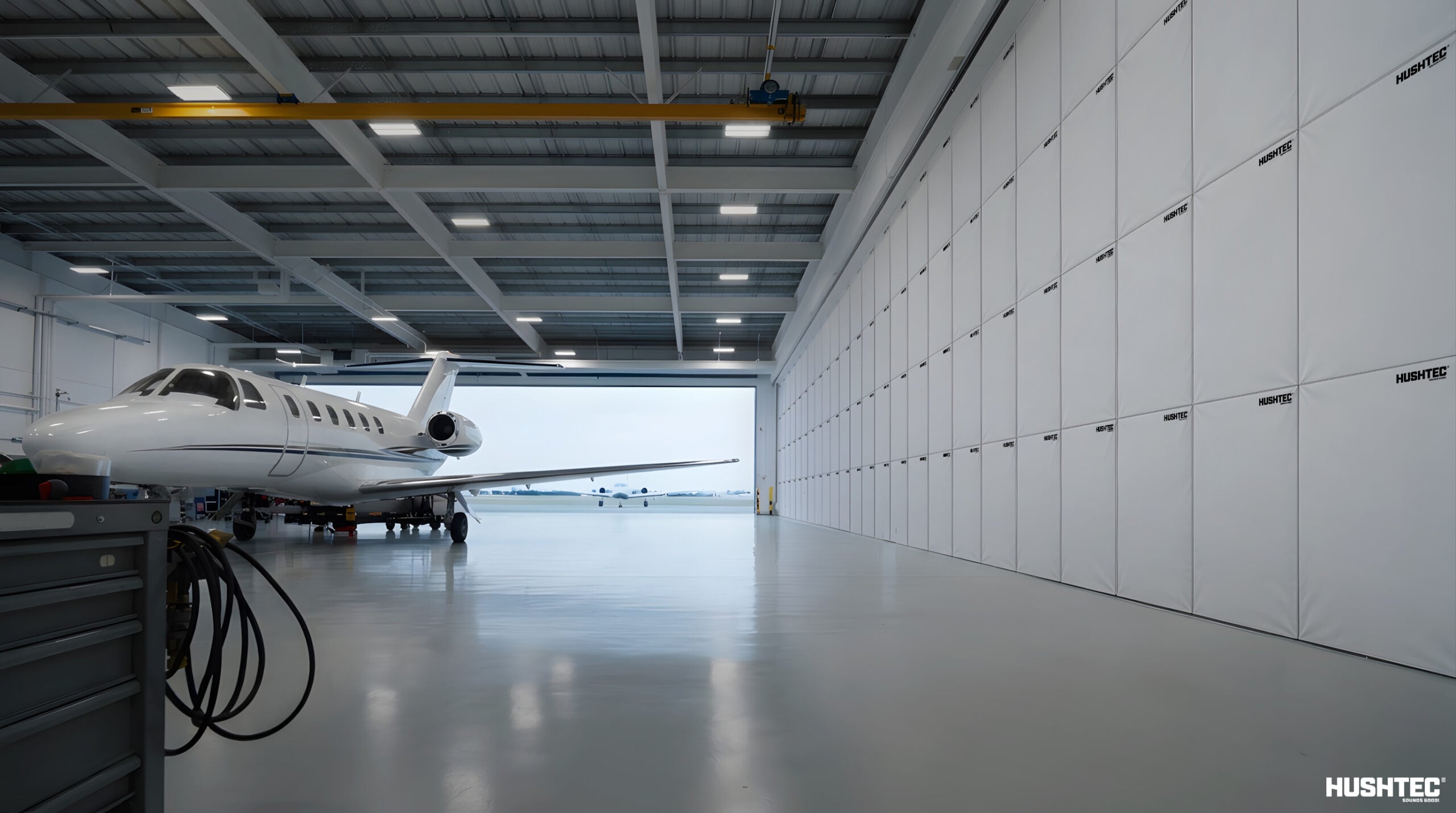
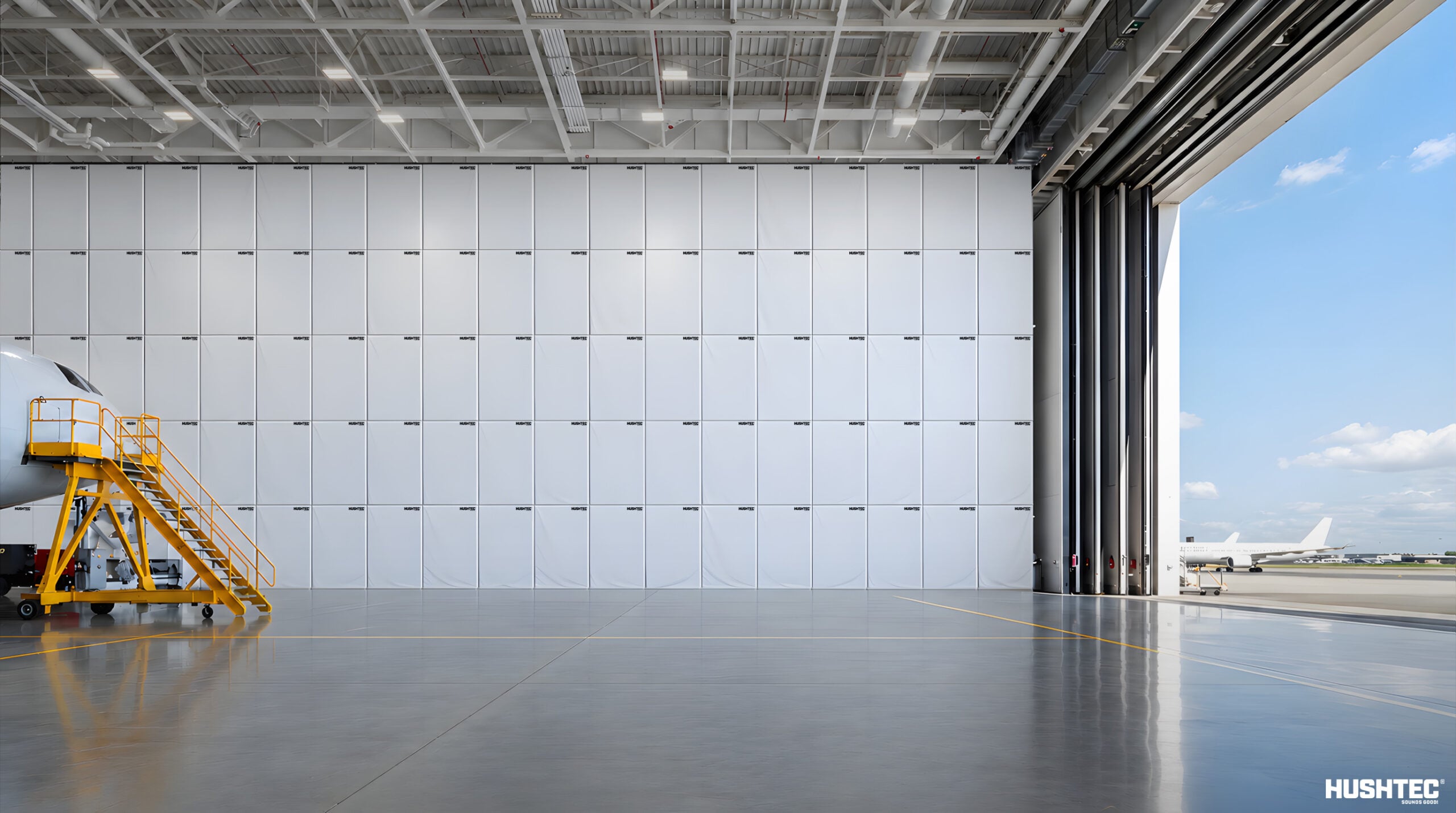
- Hangar bays: barrier panels between bays and offices, plus absorption panels to cut reverberation.
- Short, loud jobs: an acoustic tent for an engine change or structural repair.
Acoustic barriers for airport ground operations: placement basics
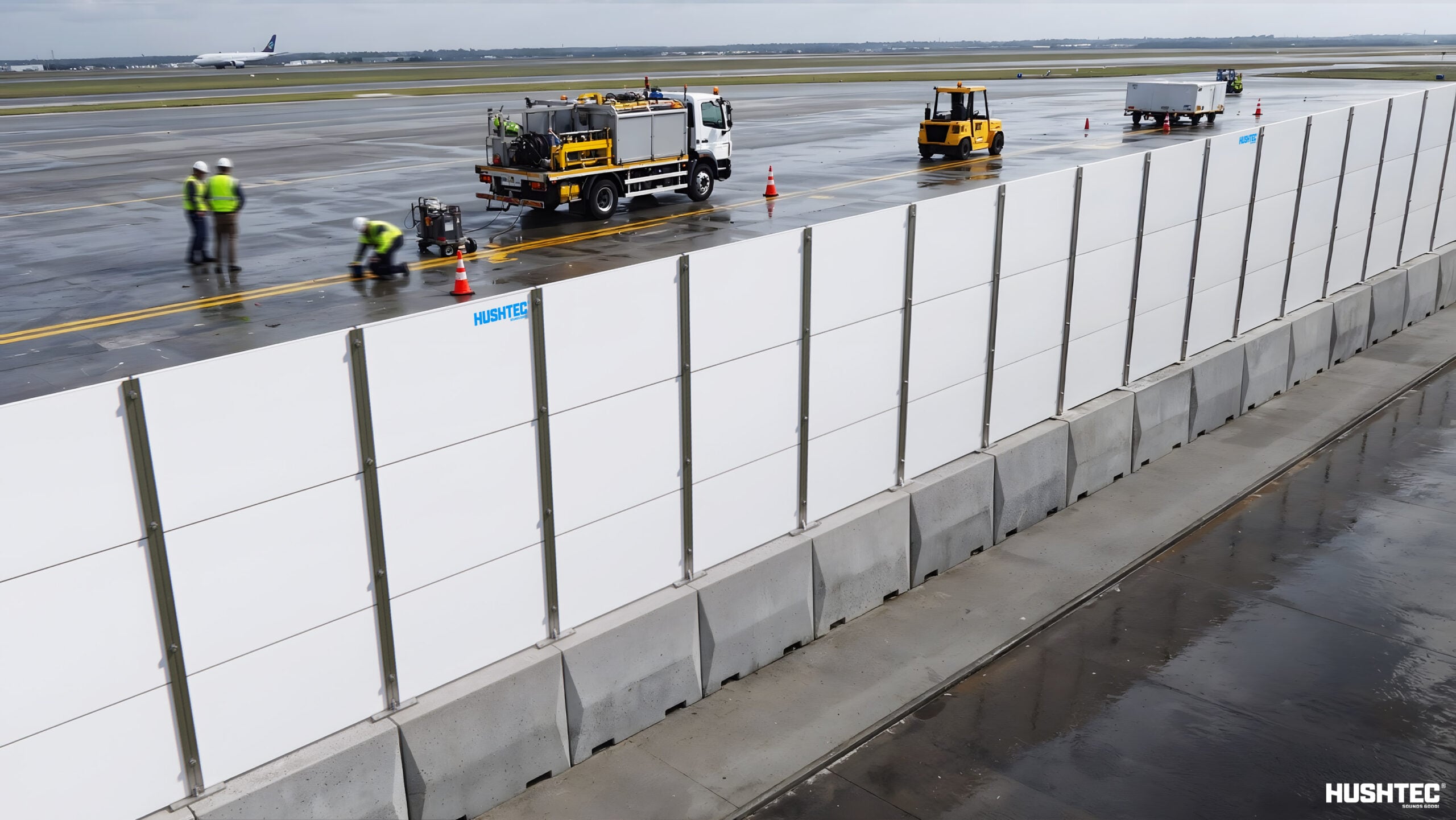
- Break the line of sight between the noise source and the receiver.
- Place the barrier close to the source or close to the receiver, never midway.
- Seal panel joints and the base, and return the ends.
- Add height and mass for low-frequency engine and APU noise.
- Put absorptive faces toward the source to stop reflections off hangar doors.
- Measure before and after, and keep the data for your safety file and the airport’s action plan.
A three-rulebook plan for your site
- Worker exposure. Assess noise levels for ramp and hangar staff, identify the highest-exposure tasks, and document the controls needed to reduce them.
- Community noise. Check which ground operations the airport has identified as noise concerns. Compare your engine run and equipment logs with any relevant community complaints to see where further controls may be needed.
- Operating flexibility. Measure before and after each control so the airport can cite your results.
- Assessment. Book a Hushtec ground operations noise assessment to set the product mix for each zone.
Frequently asked questions
What are the EU noise exposure limits for aircraft maintenance workers?
Directive 2003/10/EC sets a lower action value of 80 dB(A), an upper action value of 85 dB(A) and an exposure limit of 87 dB(A), averaged over an eight-hour day. Peak limits are 135, 137 and 140 dB(C). Each member state applies these through national law.
Does the Environmental Noise Directive cover airport ground noise?
Directive 2002/49/EC requires noise maps and action plans for major airports, and those plans cover the airport’s overall noise picture. Ground running, taxiing, and APU use contribute to it, so maintenance operations can come under scrutiny when an action plan targets ground noise.
What is the Balanced Approach Regulation?
Regulation (EU) No 598/2014 applies ICAO’s Balanced Approach at EU airports with over 50,000 civil movements a year. Authorities must weigh quieter aircraft, land-use planning and operational procedures before restricting operations for noise reasons.
What are aerospace noise control solutions?
Aerospace noise control solutions are engineered products that cut noise from aircraft maintenance and ground operations. They include modular barriers for run-up areas, shrouds for ground support equipment, and barrier and absorption panels for hangars.
Do aircraft acoustic barriers work against jet engine noise?
Yes, but the results depend on where the barrier sits and how it’s built. It needs to block the direct path between the engine and the area being protected, with gaps kept to a minimum. Low-frequency engine noise is harder to reduce, so the barrier’s height, weight and position all play a part. The level of reduction will also depend on the engine, distance and layout of the site.
Can acoustic barriers for airport ground operations move between stands?
Yes. Hushtec Portable Hushwall systems use modular sections that can be repositioned as run-up locations or stand layouts change. However, standard systems should not be assumed suitable for direct jet-blast exposure, foreign object debris (FOD) risks or fuel exposure. A version designed for those conditions is in development, so check suitability with Hushtec before specifying a system.
How do you start noise control for aircraft maintenance facilities?
Start by recording engine runs and APU tests, assessing noise exposure for ramp and hangar staff, and reviewing the site layout. Identify the areas causing the most concern, then trial a suitable control measure and take follow-up readings to see what difference it makes.
Manage Aircraft Ground Noise Across Your European MRO Operations
Hushtec designs, manufactures and installs aerospace noise control solutions for maintenance sites across Europe, with clients including Vinci Construction and Freyssinet. Contact the Europe and UK team on +44 777 111 5472 or hello@hushtecglobal.com.


