


Quick answer: An acoustic enclosure surrounds a noisy construction task, such as concrete cutting or grinding, and keeps the sound inside. In dense European city centres, a mobile enclosure on castors works best because it has a small footprint, follows the work, and can be set up in minutes. It helps you meet both the worker limits in Directive 2003/10/EC and the local noise conditions in your permit.
A renovation in a historic European town centre, an upgrade to a metro station beneath a busy square, or work on a hospital wing that must remain open. In these settings, construction noise can reach homes, shops and other occupied buildings just across the street.
This guide covers which tasks benefit from construction of acoustic enclosures, how to position them around the work, and what information to provide when showing authorities how noise will be managed. The focus is on controlling noise at the source and limiting its impact on surrounding properties.
Why dense European sites need source control
Historic centres, narrow streets and mixed-use blocks put residents, shops and schools metres from the work. Stone and render façades reflect sound into the street. Residents often live on upper floors, where a ground-level barrier does little to block their view of the work.
Permits usually restrict working hours and set limits at the nearest façade, and those rules differ between member states, regions and cities. Germany’s AVV Baulärm is one national example; many municipalities add their own conditions. Containing the loudest task at its source is one of the few measures that works under any of these regimes, because it lowers the noise before it reaches anyone, on any floor.
Which construction tasks to enclose first

| Activity | Noise issue in a dense setting | Enclosure tip |
| Concrete and stone cutting | Sharp, intermittent, echoes in narrow streets | Pass long pieces through the strip curtain |
| Grinding and finishing | Tonal noise residents notice | Keep the curtain closed; follow the hot-work permit |
| Core drilling | Long runs at one point | Lock castors and check joints before starting |
| Steel fabrication | Impact noise from fitting | Use Tent 2.0 or 3.0 for long sections |
| Paving and tile cutting | Repeated bursts through the day | Set the tent up as a fixed cutting station |
Six steps to set up an acoustic enclosure
- Map your receivers. Mark residents, schools, clinics and occupied buildings on the site plan, including upper-floor windows, with the limits from your permit.
- Rank the noisy tasks. List which activities run longest and loudest near each receiver. Enclose those first.
- Pick the size. Tent 1.0 (2.5 m × 2.5 m) for one operator, Tent 2.0 (2.5 m × 3.9 m) for longer materials, Tent 3.0 (2.5 m × 5.2 m) for several workers or multiple processes.
- Position it. Place the tent next to the task with the doorway facing away from the nearest façade. At 2.5 m wide, each tent fits within a single traffic lane.
- Use the enclosure correctly. Keep the curtain closed while cutting, check the joints whenever the unit is moved, and use the ventilation kit rather than leaving panels open. Secure the frame where it may be exposed to wind.
- Record the results. Take noise readings at nearby façades before and after setting up the enclosure. Keep the measurements with your site records for reference during permit reviews.
Worker protection across the EU
Directive 2003/10/EC sets a lower exposure action value of 80 dB(A), an upper exposure action value of 85 dB(A) and an exposure limit of 87 dB(A). It requires employers to reduce noise at source through technical and organisational measures before relying on hearing protection. An enclosure around the cutting station lowers exposure for nearby workers. The operator inside still needs hearing protection suited to the tool.
What performance to expect

Hushtec rates its Acoustic Tent range at up to 66 dB, using ISO lab-tested Hushtec Premium panels rated STC 32 and NRC 0.9. European consultants usually work with the Rw rating from EN ISO 717-1, so ask Hushtec for the Rw value on the test report. The high NRC also reduces echo inside the tent, which makes the working space more comfortable.
On site, gaps at panel joints, an open doorway and sound travelling through the structure reduce the figure. Sealing and doorway discipline decide how much of the rated performance you see. Laing O’Rourke reported that Hushtec panels cut its site noise straight away, letting the team keep working through the night on an urgent project and finish ahead of schedule.
Practical constraints and how to handle them

- Light. The transparent roof lets daylight in. Add the internal lighting kit for basements and night shifts.
- Dust. Cutting concrete and stone releases respirable crystalline silica. Keep wet cutting and on-tool extraction running inside the tent, and add the ventilation kit for long tasks.
- Fire. The panels are fire retardant and fibreglass-free. Hot work still needs a permit, a fire watch, and an extinguisher at the doorway.
- Weather. The tents resist water and UV. Fit the anchor kit on exposed sites.
- Sustainability. Hushtec states that 90% of the panel materials are recyclable, and the frame and roof are reusable. That helps when tenders score circularity.
- Transport. Each tent packs onto one pallet, so it travels between projects and countries.
- Communication. In loud zones, pair the tent with a Hushtec Hushbox for clear emergency calls.
Enclosure, barrier or both?
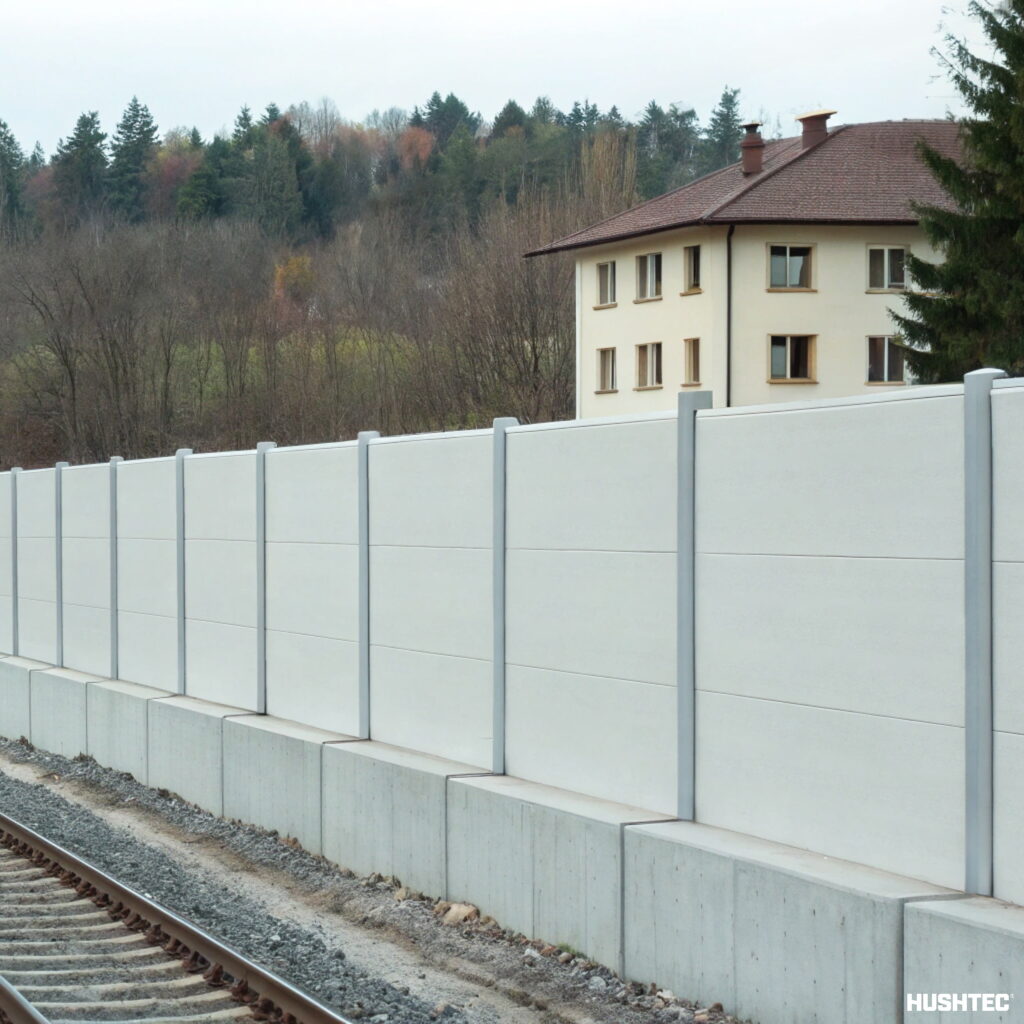
An enclosure contains noise at the source. A barrier, such as Hushtec Premium Barriers on the site fence, interrupts the sound path to ground-level receivers. Barriers handle general site noise across a wide area; enclosures handle one intense task in one place. Where residents live on upper floors, the enclosure does most of the work, because it contains the noise in every direction. Hushtec’s client list includes Vinci Construction and Freyssinet.
The Hushtec Acoustic Tent range

| Model | Footprint | Height | Best for |
| Acoustic Tent 1.0 | 2.5 m × 2.5 m | 2.2 m | A single cutting or grinding station |
| Acoustic Tent 2.0 | 2.5 m × 3.9 m | 2.2 m | Longer materials, more tools |
| Acoustic Tent 3.0 | 2.5 m × 5.2 m | 2.2 m | Several workers, drilling, large-format fabrication |
Each tent rolls on lockable castors, packs onto one pallet, resists water and UV, and comes with a 1-year warranty. Custom branding on the outer panels is available.
Frequently asked questions
What is an acoustic enclosure for construction?
It is a structure that surrounds a noisy construction task and contains the sound at its source. Mobile versions, like Hushtec Acoustic Tents, roll on castors and move with the work.
Do EU countries share one construction noise limit?
No. Worker exposure follows Directive 2003/10/EC, but neighbourhood limits and hours come from national and municipal rules and your permit.
Does an acoustic enclosure reduce worker exposure?
It reduces exposure for people around the enclosure. The operator inside still needs hearing protection.
Does an enclosure help residents on upper floors?
Yes. Unlike a ground-level barrier, an enclosure contains the noise in every direction, including upwards.
Can I move a Hushtec tent between countries?
Yes. It packs onto a single pallet and reassembles in minutes.
Are the tents recyclable?
Hushtec states that 90% of the panel materials are recyclable, and the frame and roof are reusable.
Can I grind inside the tent?
Yes, under your site’s hot-work permit with a fire watch. The panels are fire-retardant.
Will it fit on a narrow street?
Each tent is 2.5 m wide, so it fits within a single traffic lane.
Talk to Hushtec About Construction Acoustic Enclosures across EU
Share your permit limits, site plan and programme, and we will recommend tent sizes, placement and any perimeter barriers. Book a free consultation, email hello@hushtecglobal.com or call +44 777 111 5472.