


NIOSH data shows that 38% of US manufacturing workers were exposed to hazardous noise in 2023, while 12% reported hearing difficulties. Hearing conservation programmes, earplugs, and regular hearing tests are important, but they don’t remove workplace noise. Operators may still need to raise their voices over production equipment, struggle to hear alarms or spend long shifts working in noisy conditions.
Manufacturing environments also change as production needs shift. A new part may require a different cell setup, a robot may be added, or equipment such as compressors may be moved. An enclosure that worked for the previous layout may no longer fit.
This guide covers common noise sources in advanced manufacturing, the control options available for different equipment types, and how to plan noise-control solutions for advanced manufacturing facilities that can be adjusted as production lines change.
What OSHA expects on the floor
OSHA’s occupational noise standard, 29 CFR 1910.95, sets two thresholds that matter most to a plant manager.
| Threshold | 8-hour time-weighted average | What it triggers |
| Action level | 85 dBA | A hearing conservation program: monitoring, audiometric testing, hearing protectors, training |
| Permissible exposure limit | 90 dBA | Feasible administrative or engineering controls first; hearing protection if they fall short |
OSHA puts engineering controls ahead of earplugs above the limit. A barrier, enclosure or shroud reduces the noise for every worker in the area, including visitors and contractors who skip the fit test.
Where factory noise comes from
On an advanced manufacturing floor, noise comes from a handful of source types, each with its own character.
| Source | Noise character | Typical treatment reduction |
| CNC machines and robotic work cells | Continuous spindle and tool noise, plus intermittent impacts | Basic enclosure: about 9–10 dB(A) |
| Stamping and hydraulic presses | High-intensity impact noise, often the loudest single source on the floor | Varies; confirm on site |
| Compressors and blowers | Continuous mechanical noise | Silencer treatment: about 6–10 dB(A) |
| Compressed air and pneumatics | Hiss and exhaust noise at specific points | Up to about 15 dB(A) on specific sources |
| Material handling | Conveyors and forklifts, amplified by hard surfaces and open layouts | Varies; confirm on site |
These reductions are representative figures from industrial acoustic references. Your results depend on the equipment, treatment design, and building, so measure before you specify.
Industrial noise control solutions, matched to each source

Good manufacturing facility noise control treats each source on its own terms, then deals with the room.
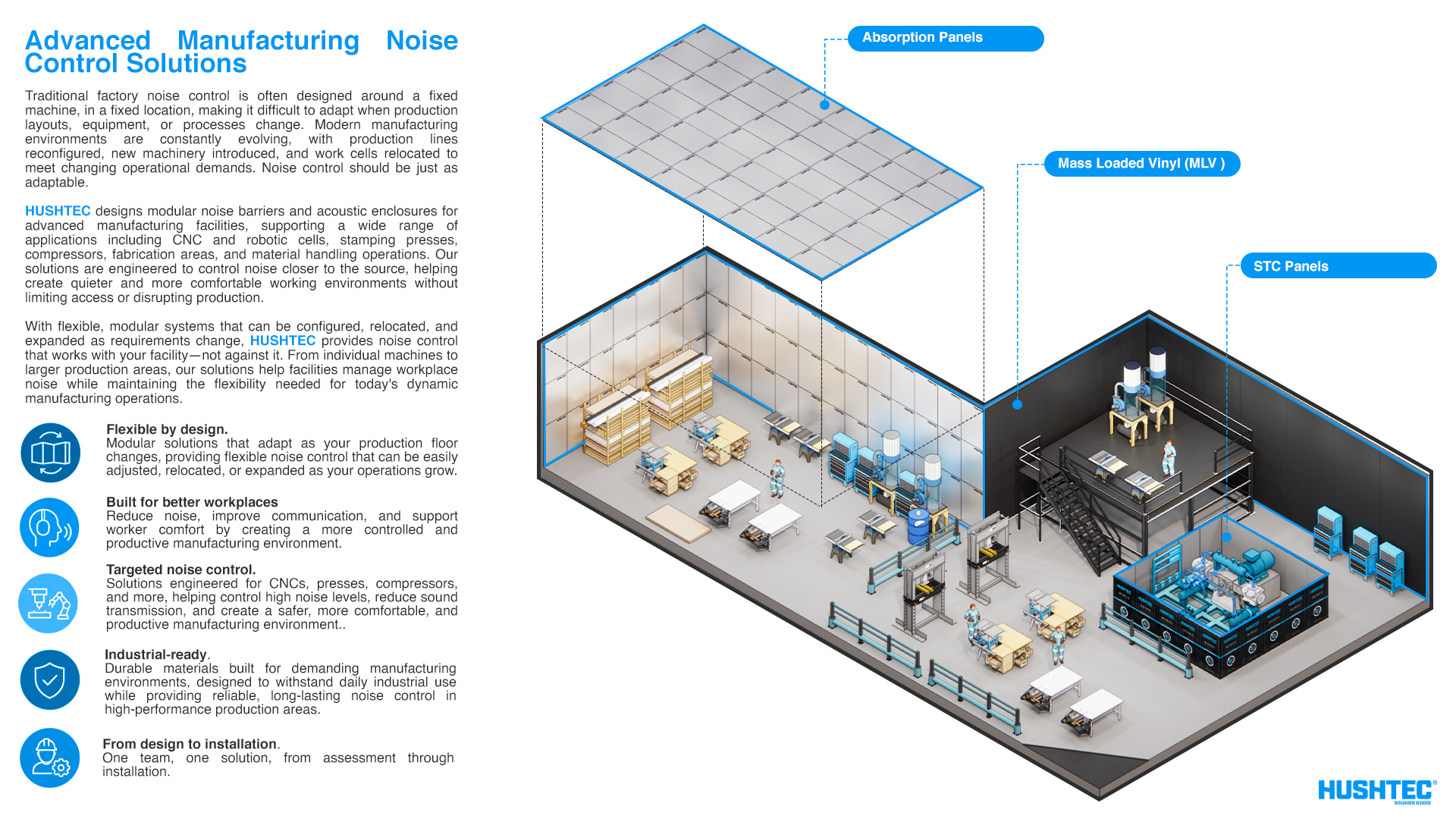
CNC cells and robotic work cells. Hushtec STC Panels and modular barrier walls close off a cell on three or four sides. The STC32 panel carries an STC 32 rating, weighs 10 kg/m² and mounts with hook-and-loop or stainless eyelets, so you can open a side for maintenance or move the whole cell.
Presses. A Hushtec Custom Shroud wraps the press frame, with absorption panels on nearby walls to stop impact noise bouncing across the floor.
Compressors and blowers. A Custom Shroud around the unit, or an indoor barrier wall between the compressor bay and the work areas.
Open-floor reverberation. Absorption panels and ceiling baffles reduce sound bouncing around the production hall. They won’t silence an individual machine, but they can bring down the overall noise level across the floor.
Many plants use a combination of measures: enclosures around the loudest equipment, absorption on ceilings and walls, and barriers to separate noisy production areas from quieter workspaces.
Industrial acoustic enclosures for production equipment: fixed or modular?
A fixed enclosure is built around a machine and stays there. It can provide effective noise reduction, but changes to the production line can make it difficult or expensive to modify.
Modular enclosures use panels and frames that can be dismantled and reassembled elsewhere. If a machine moves or a production cell is reconfigured, the enclosure can be adjusted to suit the new layout. This can be useful in plants with high-mix production, robotic cells or frequent line changes.
Before choosing an enclosure, check three practical details:
- Access. Operators and maintenance teams need suitable doors, viewing panels and removable sections. If routine work is difficult, panels may be left open, and the enclosure won’t perform as intended.
- Heat and airflow. Some machines generate considerable heat and need ventilation. Plan airflow openings so they don’t become easy paths for noise to escape.
- Gaps and openings. Cable entries, conveyor openings and spaces beneath panels can let sound through. Consider these in the enclosure design and seal them where practical.
Portable acoustic barriers for manufacturing plants
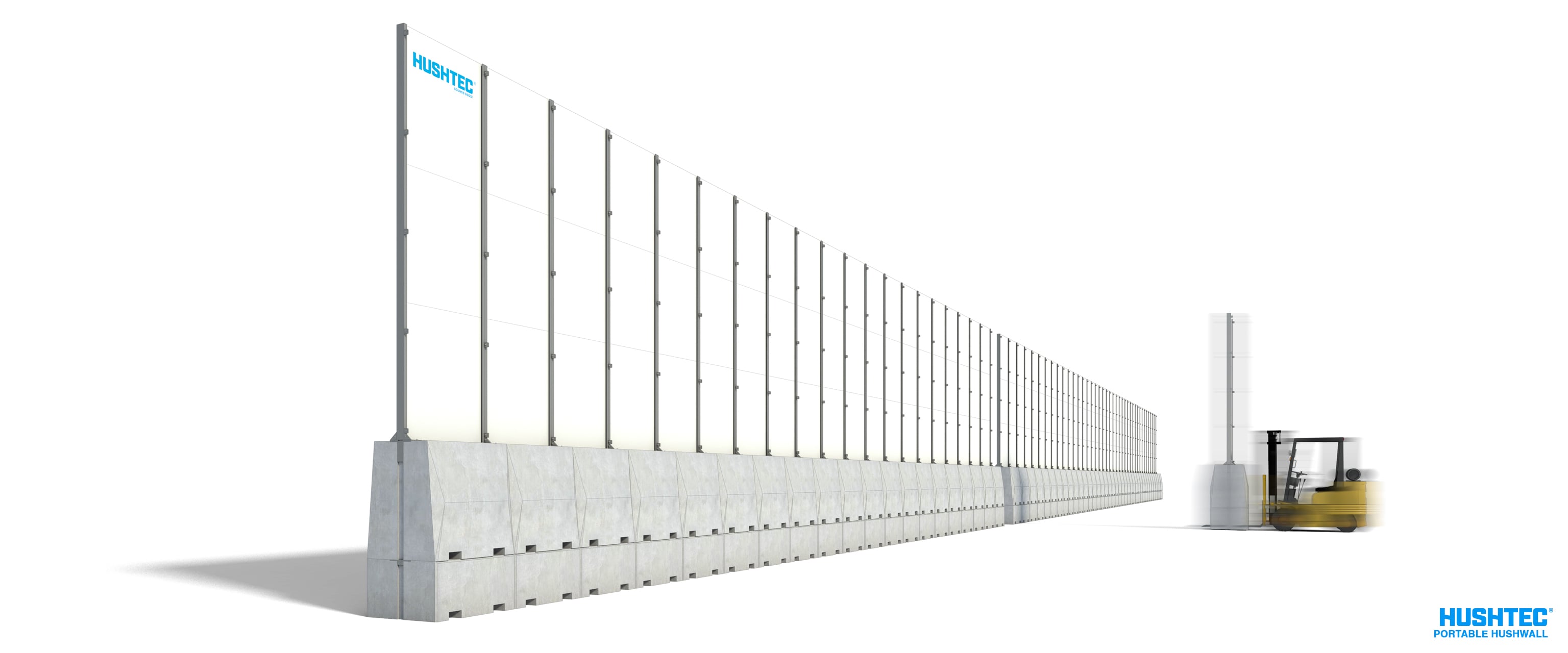
Not every noise problem needs a full enclosure. Portable acoustic barriers for manufacturing plants work well for temporary jobs, commissioning and quiet zones.
- Commissioning a new line. Screen test runs from the rest of the floor without waiting for permanent works.
- Maintenance shutdowns. Contain grinding, cutting and fastening noise during planned outages.
- Quality and inspection areas. Separate measurement and inspection benches from the production line.
The Hushtec Portable Hushwall installs in sections and can be redeployed as layouts change. For operators who need to make calls or report hazards on a loud floor, the Hushtec Hushbox is a wall-mounted communication booth that cuts ambient noise by 15–20 dB.
How to start
- Map the floor. Mark every source, its operating hours, and which workers spend time nearby.
- Measure exposure. Use noise dosimetry on real shifts, not spot readings.
- Rank the sources. Start with the loudest source that affects the most people, usually a press or a cluster of CNC cells.
- Book a site assessment. A Hushtec factory floor noise assessment confirms your noise profile and the right mix of enclosures, barriers and absorption.
- Measure again. Before-and-after data supports your hearing conservation records.
Frequently Asked Questions
What are advanced manufacturing noise control solutions?
Advanced manufacturing noise control solutions are engineered products that cut noise from CNC machines, robotic cells, presses, compressors and material handling. They include modular enclosures, portable barriers, equipment shrouds and absorption panels. Hushtec designs them to be reconfigured as production lines change.
What noise level triggers an OSHA hearing conservation programme?
Under OSHA regulations, employers must establish a hearing conservation programme when workers’ noise exposure reaches or exceeds 85 dBA over an eight-hour time-weighted average. At 90 dBA, employers must implement feasible engineering or administrative controls to reduce exposure. If those measures aren’t enough, employers must also provide and require the use of hearing protection.
How much noise reduction can a CNC machine enclosure give?
A basic CNC enclosure typically gives about 9 to 10 dB(A) of reduction. Better sealing, heavier panels and absorptive linings can improve on that. A factory floor assessment gives figures specific to your machines.
What are industrial acoustic enclosures for production equipment?
Industrial acoustic enclosures for production equipment are panel systems built around a machine or cell to contain its noise. Modular versions use panels and frames you can take apart and rebuild when the line moves, unlike fixed enclosures built once for one machine.
Do portable acoustic barriers work in manufacturing plants?
Yes. Portable acoustic barriers for manufacturing plants suit commissioning, maintenance shutdowns and quiet zones such as inspection areas. They block direct sound between a source and nearby workers and can be redeployed when layouts change.
Can noise control be added to a plant that’s already running?
Yes. You can fit noise control measures to existing production areas, often without stopping the entire operation. Modular systems are useful when equipment is difficult to move, or production must continue during installation. The work starts with an assessment of the noise sources, layout and access requirements.
Does manufacturing facility noise control guarantee OSHA compliance?
No. Installing acoustic products does not, by itself, guarantee OSHA compliance. They can reduce noise exposure at the source and form part of a wider hearing conservation programme. Before-and-after measurements can also help document the effect of the changes and identify where further action may be needed.
Keep Manufacturing Noise Under Control as Production Evolves
As manufacturing operations grow and production layouts change, noise control solutions need to adapt. From acoustic enclosures and custom equipment shrouds to modular barriers and absorption panels, the right combination can help reduce workplace noise while maintaining equipment access and production flexibility.
Hushtec handles assessment, design, manufacturing and installation of advanced manufacturing noise control solutions under one point of contact. Call 201-679-1268 (USA and Canada) or email hello@hushtec.com.