

Data centres are no longer out-of-sight, out-of-mind facilities. Today’s hyperscale campuses and edge computing nodes sit inside urban fringe zones, next to residential streets, business parks, and schools. The servers inside run silent. The infrastructure keeping them cool and backed up does not. Growing community concerns and stricter planning requirements mean data center noise compliance in US jurisdictions is now a critical part of facility design, operation, and expansion planning.
Cooling towers, precision air conditioning units, diesel generators, and UPS exhaust stacks collectively produce constant broadband noise — 24 hours a day, 7 days a week, 365 days a year. Planning authorities in Ashburn VA, Phoenix AZ, Chicago IL, Dallas TX, and Toronto ON are now enforcing tighter operational noise limits on data centre sites.
This article covers what is driving the compliance crackdown, where the noise is actually coming from, and what acoustic solutions are being deployed on operational sites right now.
Why data center noise compliance US has become a planning battleground
The US data centre market — led by Northern Virginia, Phoenix, and Chicago — is the world’s largest by capacity. Noise ordinances vary by municipality, but complaints and zoning disputes are accelerating across all major markets.
In the US, there is no single federal operational noise standard for data centres. Compliance is driven by local municipal ordinances, planning conditions attached to use permits, and — where applicable — state environmental agency rules. In Canada, provincial environmental protection acts (Ontario EPA, BC EPA) govern operational site noise using LA90-based assessment methods comparable to international standards.
Three forces are converging: closer neighbours (residential development is eating into what were buffer zones), stricter environmental noise standards, and longer operating hours. Diesel generator testing, once tolerated at off-peak times, now draws formal complaints.
The four noise sources operators most underestimate
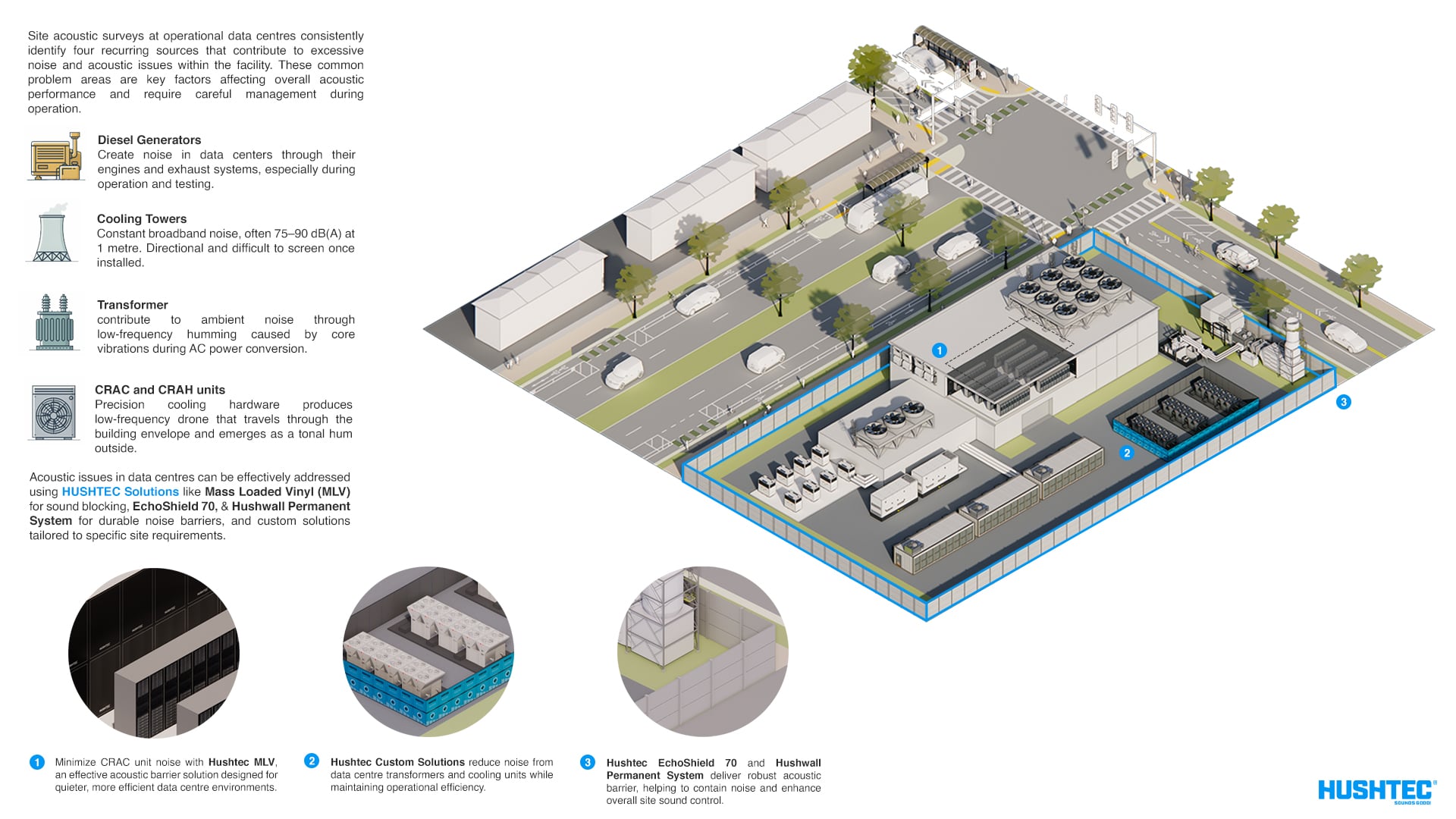
Understanding these recurring noise sources is essential for maintaining data center noise compliance US jurisdictions where municipal enforcement is becoming increasingly active.
Site acoustic surveys on operational data centres consistently identify four recurring problem sources:
- Cooling tower fans — constant broadband noise, often 75–90 dB(A) at 1 metre. Directional and difficult to screen once installed.
- CRAC and CRAH units — precision cooling hardware produces low-frequency drone that travels through the building envelope and emerges as a tonal hum outside.
- Diesel generators — a single 2 MW standby set at full load produces 105–115 dB(A) at source. Even with integral enclosures, exhaust noise bleeds through louvres.
- UPS exhaust and transformer hum — 100 Hz and 200 Hz tonal components that a standard rating will not adequately address. Under OSHA / municipal ordinance, tonal noise attracts a penalty correction that can push a marginal site into non-compliance overnight.
What data center noise compliance in US sites looks like under OSHA and municipal ordinances
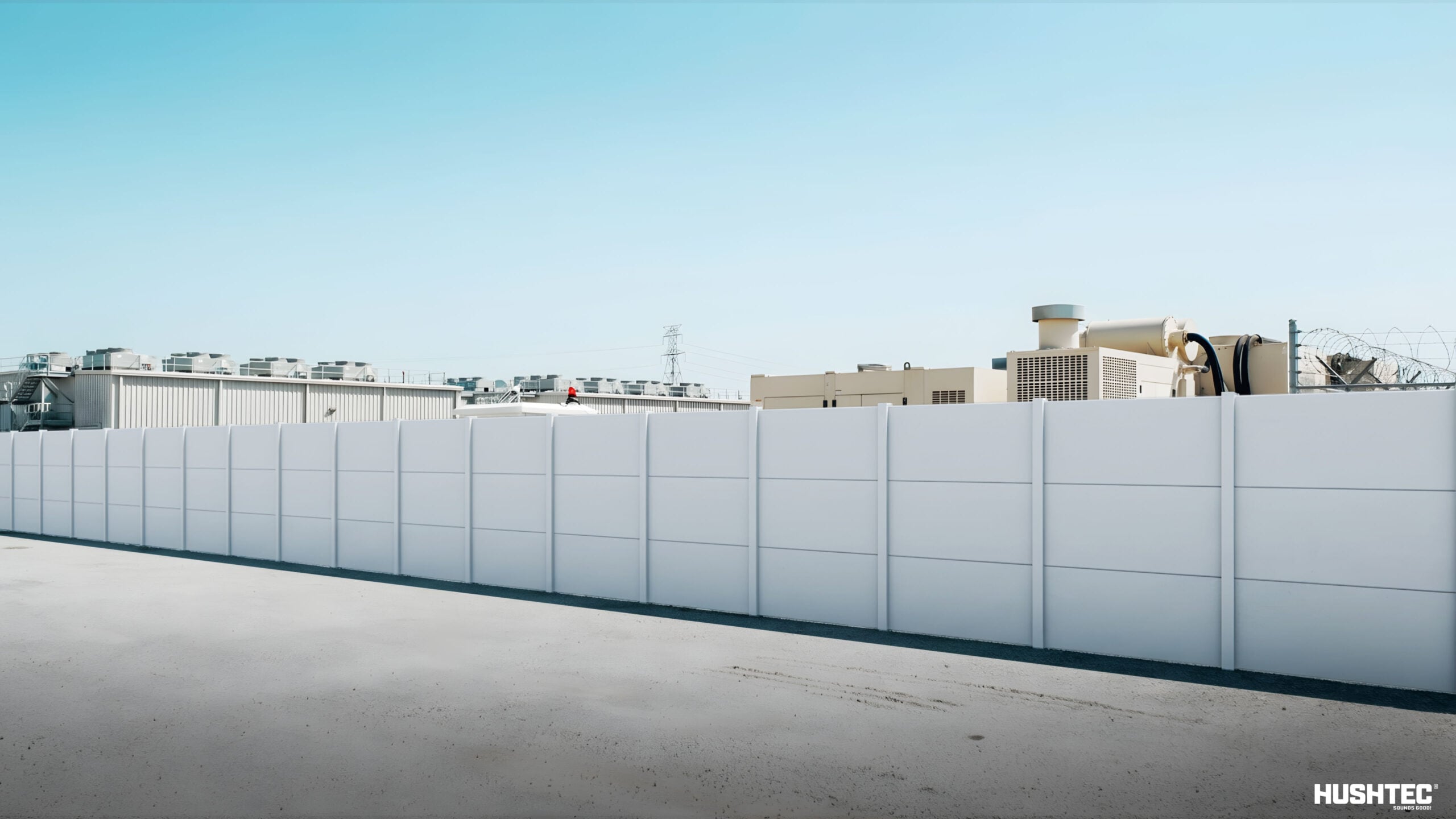
Planning consent noise conditions under OSHA 29 CFR 1910.95, local municipal noise ordinances, and EPA guidance now typically require operators to demonstrate that:
- Limits vary by municipality. Common daytime limits range from 55–65 dB(A) at the property line; night-time limits of 45–55 dB(A) are increasingly enforced in mixed-use and residential-adjacent zones. Tonal noise is treated as a nuisance factor and attracts complaint-driven enforcement even where numerical limits are met.
- Generator test events are one of the most frequent sources of formal noise complaints at US data centre sites. Local ordinances in Ashburn, Phoenix, and Chicago all impose time-of-day restrictions on test events exceeding 65 dB(A) at the boundary.
- Meeting these conditions on an existing site — one designed without acoustic retrofit in mind — is the challenge operators are calling suppliers to solve.
The assessment methodology matters because successful data center noise compliance in US projects depend on accurately measuring and managing operational noise against local requirements. In the US, there is no single federal operational noise standard for data centres. Compliance is driven by local municipal ordinances, planning conditions attached to use permits, and — where applicable — state environmental agency rules. In Canada, provincial environmental protection acts (Ontario EPA, BC EPA) govern operational site noise using LA90-based assessment methods comparable to international standards.
Solution approaches: what is being deployed
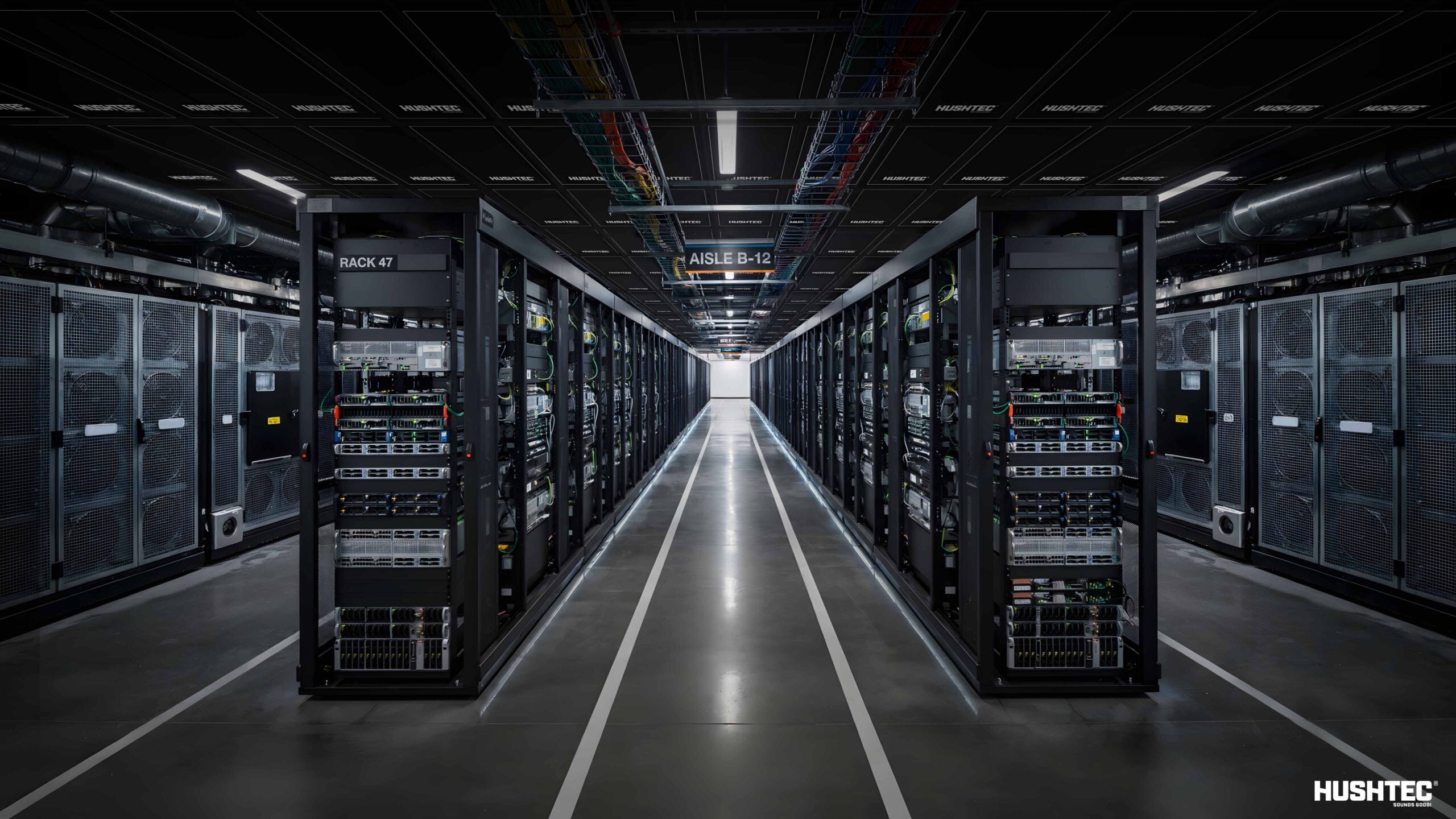
Effective data centre noise control follows a layered approach rather than a single product fix.
This layered methodology is widely recognised as the most effective pathway to achieving data center noise compliance in US data centre environments.
Permanent modular noise walls
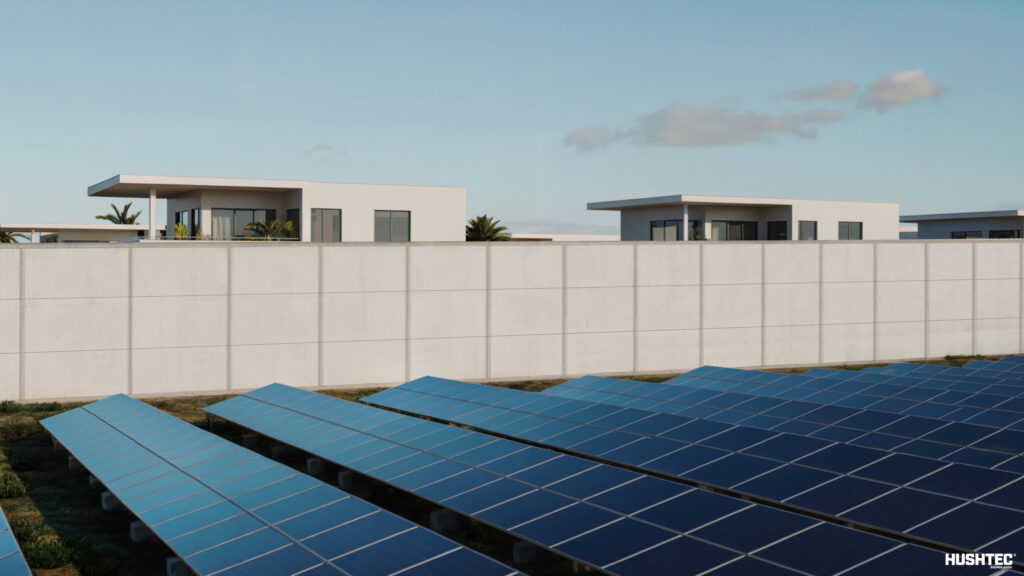
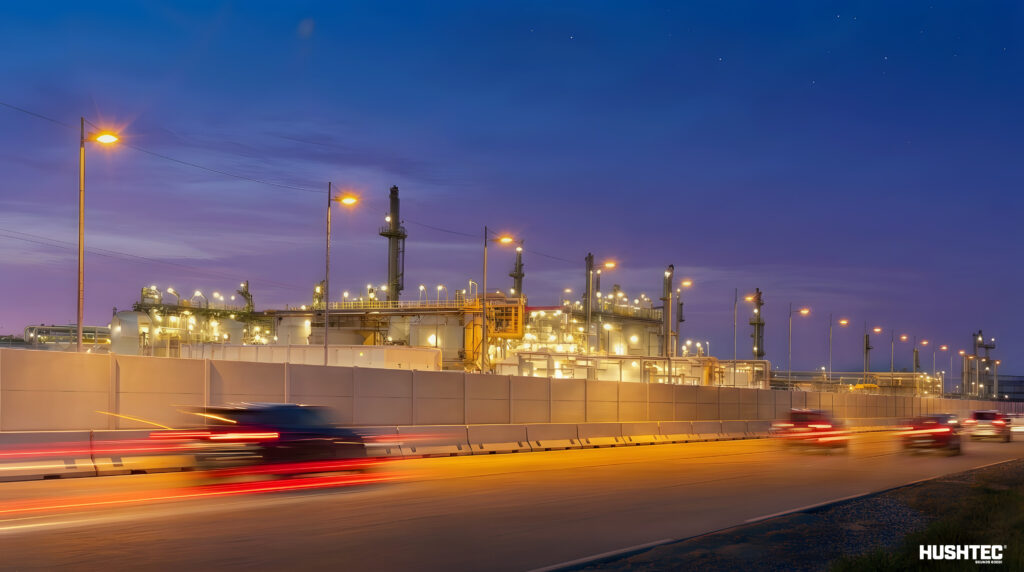
Where cooling towers and generators are accessible from site perimeter, a permanent EchoShield-class wall system rated to 70 dB insertion loss provides the baseline shield. These systems are engineered to site-specific geometry — L-shaped, U-shaped, and full-enclosure configurations are all possible. Unlike poured concrete walls, modular systems can be reconfigured as plant layouts change.
Generator enclosure upgrades
Most standby diesel sets come with an OEM silencer rated to the base standard. That is rarely sufficient. Hushtec custom shrouds and MLV wrapping applied to the generator canopy, exhaust pipework, and louvre faces can deliver an additional 15–25 dB(A) over the OEM specification — without restricting cooling airflow or access for servicing.
Cooling tower screening
Free-standing or roof-mounted barrier systems around cooling towers must account for both direct noise radiation and reflection off adjacent building faces. Transparent barrier panels (Vision 5) are used on sites where visual access to equipment is required for operational monitoring — a common requirement on roof-level installations in urban areas.
Tonal noise treatment
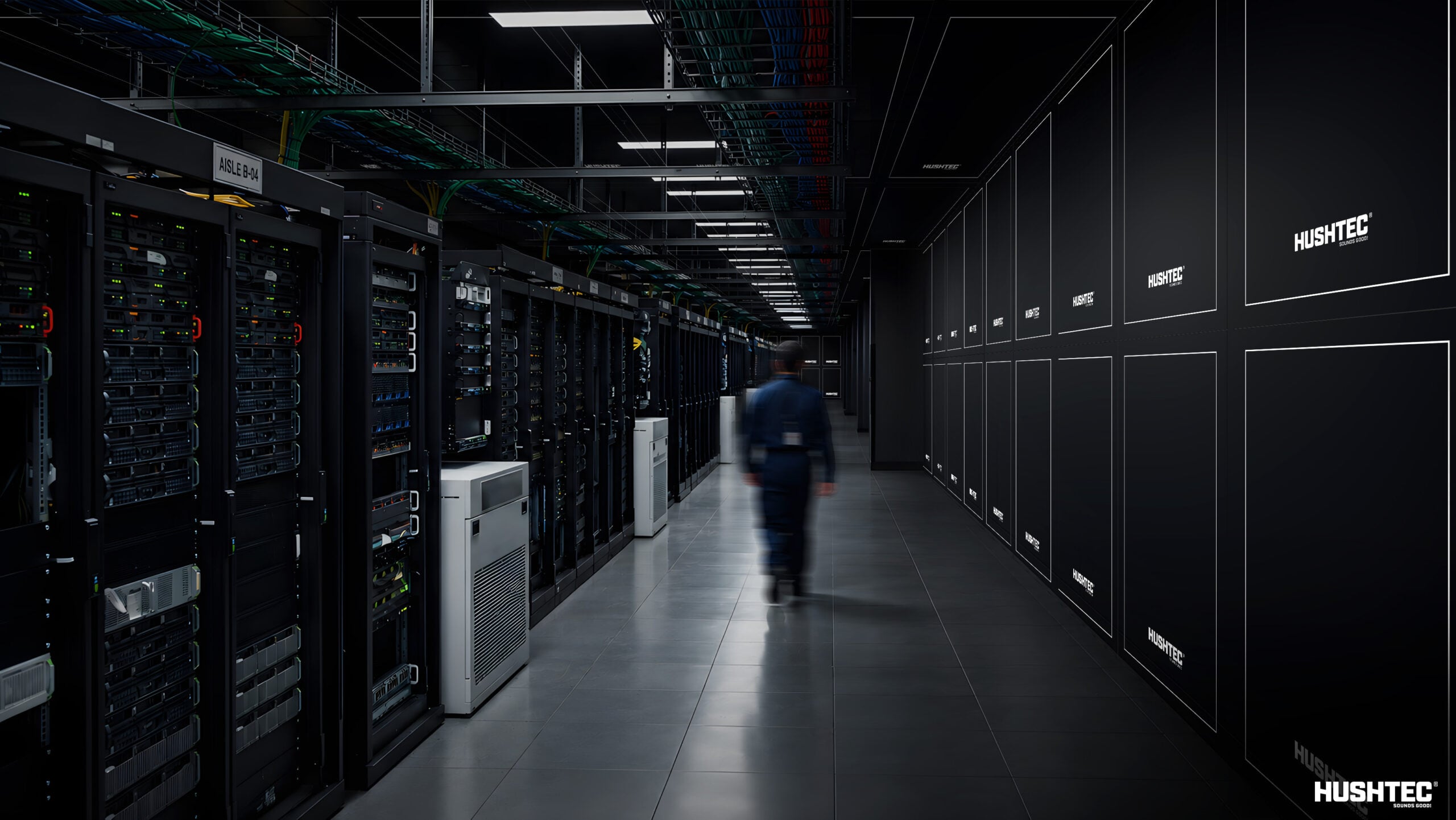
Where CRAC units or transformers produce tonal hum, absorption panels installed inside plant rooms or on the inner face of generator enclosures break up the standing wave patterns. This is the intervention that barrier-only approaches consistently miss — and it is the one most likely to clear the tonal penalty correction under OSHA / municipal ordinance.
Procurement and lead time realities
Data centre operators working to an improvement notice typically have 90–120 days to demonstrate compliance. Custom acoustic systems on tight timelines are achievable but early engagement matters. Sites that contact Hushtec with three months’ notice consistently achieve better outcomes than those calling six weeks before a deadline.
Early planning significantly improves the likelihood of achieving data center noise compliance US markets before regulatory deadlines are reached.
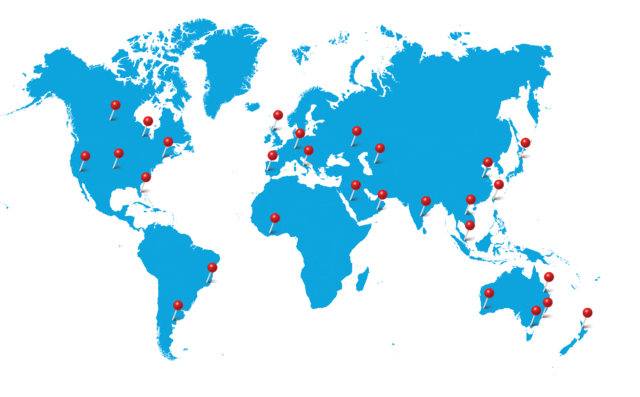
Hushtec supplies and installs across North America. Contact our US/CA team for site-specific supply and installation programmes.
For operators planning new builds, the most cost-effective intervention is always at design stage. Specifying modular wall systems and enhanced generator enclosures at consent stage adds 2–4% to mechanical plant costs but avoids five-figure retrofit bills post-occupation.
Key takeaways
- Cooling tower and generator noise is the primary compliance risk on operational data centre sites — not server noise.
- Tonal noise components attract a planning penalty correction under OSHA / municipal ordinance that can push a site into breach even when overall levels appear acceptable.
- A layered approach — permanent barriers, source enclosures, and absorption treatment — outperforms any single product intervention.
- Retrofit is achievable within improvement notice timescales, but requires early supplier engagement.
- Hushtec solutions are deployed on data centre sites across Ashburn VA, Phoenix AZ, Chicago IL, Toronto ON and beyond. Contact us to discuss your site requirements.
Frequently Asked Questions
What regulations affect data center noise compliance US and Canadian data centres?
Data centres in this region are primarily governed by OSHA 29 CFR 1910.95, local municipal noise ordinances, and EPA guidance. Limits vary by municipality. Common daytime limits range from 55–65 dB(A) at the property line; night-time limits of 45–55 dB(A) are increasingly enforced in mixed-use and residential-adjacent zones. Tonal noise is treated as a nuisance factor and attracts complaint-driven enforcement even where numerical limits are met.
How much noise reduction can be achieved on a live site?
A layered approach — combining permanent modular walls, source enclosures, and absorption treatment — typically delivers 20–40 dB(A) reduction at the site boundary. The Hushtec EchoShield 70 system is independently tested to 70 dB insertion loss under ideal conditions; real-world performance on data centre sites typically delivers 25–35 dB depending on flanking paths and plant geometry.
Can barriers be installed without taking equipment offline?
In most cases, yes. Modular wall systems can be installed around operating cooling towers and generators without interrupting service. Generator enclosure upgrades may require a brief planned maintenance window — typically 4–8 hours — to apply wrapping to exhaust pipework.
What is the difference between a noise barrier and a noise enclosure for a data centre?
A noise barrier screens sound propagating in a specific direction. It works best when the source is fixed and the receptor is in a defined location. A noise enclosure surrounds the source on multiple or all sides, containing noise before it radiates. For cooling towers in open compounds, a three- or four-sided barrier is often sufficient. For generators with significant roof-level exhaust noise, a full enclosure or canopy upgrade is necessary.
How quickly can Hushtec supply and install?
Standard modular wall systems are available within 3–6 weeks from order confirmation. Custom-engineered enclosures require 6–10 weeks for manufacturing. Hushtec supplies and installs across North America. Contact our US/CA team for site-specific supply and installation programmes.
Do data centre acoustic solutions need to be fire-rated?
Where barriers or enclosures are installed within or adjacent to plant rooms, fire-rated materials are required. Hushtec offers fire-rated variants of its barrier and enclosure products. This is a specification detail that must be confirmed at survey and design stage.